
Open this photo in gallery:
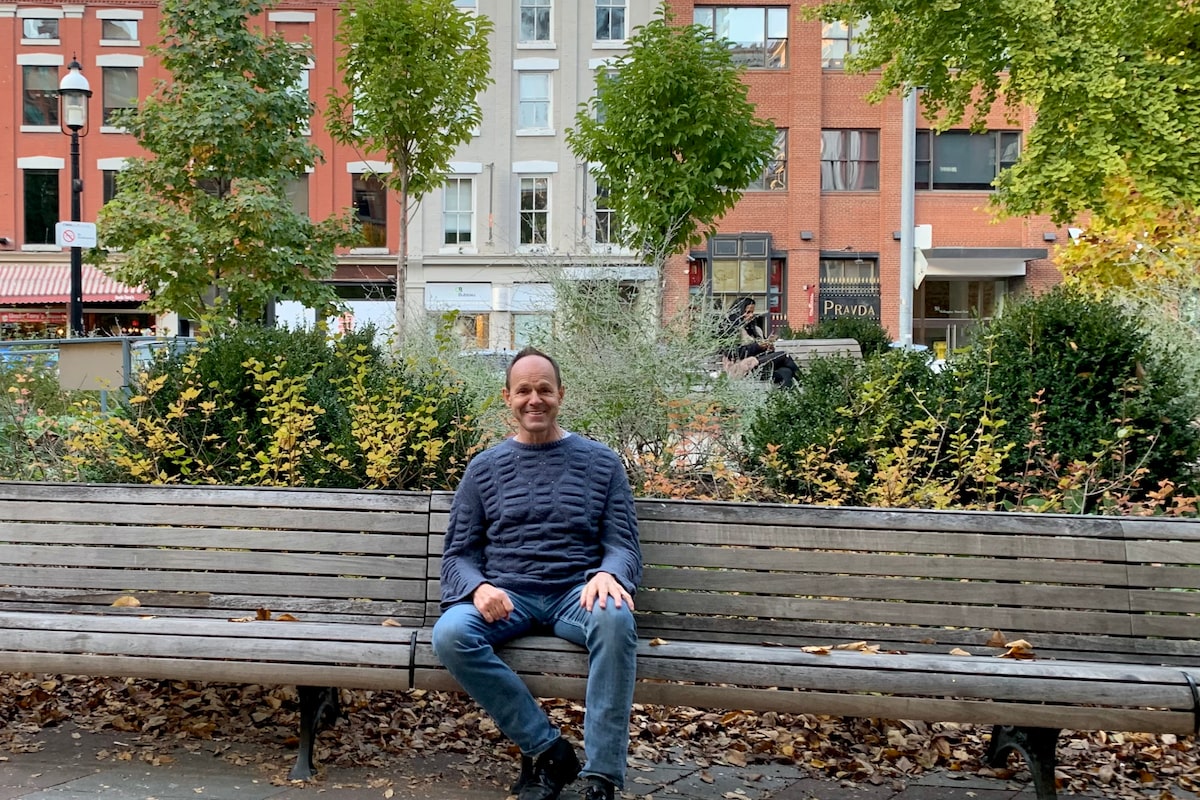
Landscape architect Claude Cormier visits Berczy Park in Toronto, which his office redesigned in 2017.Alex Bozikovic/The Globe and Mail
Claude Cormier was a genius. He was one of a kind. These are clichés, but they are true – of Mr. Cormier, the Montreal landscape architect who died in 2023, and also of his work.
He was one of the greatest designers Canada has ever produced. How can we protect his body of work? And what can our cities learn from him?
Mr. Cormier had a 15-year run of creating spaces that bring people together. He and his firm CCxA created Montreal’s Clock Tower Beach and most of Toronto’s best recent parks. You may not know his name, but you have likely seen the pink umbrellas of Toronto’s Sugar Beach, the giant ring at Place Ville-Marie in Montreal or the lipstick-red benches at Love Park, where Torontonians gather around a big heart-shaped pond.
In his parks, there are places to sit. There is shade. There are usually big trees. There is something to look at – a colourful spectacle to be appreciated alongside other people. Cormier’s work delivered these fundamentals (which are often neglected) along with technical expertise and a huge dash of wit.
This winter, Toronto designers and advocates are pushing to recognize the scope of achievement and to protect the places he created.
An event during the DesignTO Festival in February brought together colleagues and landscape-architecture experts for discussion, along with oral history videos produced by the Cultural Landscape Foundation.
“He gave us permission to be a little wild, and a little promiscuous at the right moment,” said one of the panelists, the planner and ecologist Nina-Marie Lister. “He would often say to us, ‘Loosen up!’ The result was a commitment to public joy, the freedom to be who you are.”
Few landscape architects earn such a poetic vocabulary. But that was Cormier: endlessly energetic, utterly extroverted, and a fountain of ideas. Raised on a farm in Quebec, he loved plants, and he grew to love cities equally. In Montreal, Toronto and in his studies at Harvard, he acquired an arsenal of intellectual and aesthetic tools.
In one of the interview videos, Cormier describes himself as the love child of Frederick Law Olmsted and Martha Schwartz. One parent was the famous father of American landscape architecture, whose faux-natural landscapes served the working people of the 19th-century city; the other a mischievous postmodernist who launched herself in the 1980s with a garden that included sculptures of bagels.
Cormier fit these pieces together. His parks always had a big idea. In Toronto, he took a waterfront site that faced a sugar refinery and created Sugar Beach: a park punctuated by pink candy-coloured umbrellas. He added a piece of bedrock to evoke the Canadian Shield and an allée of trees through which visitors stroll as if on a catwalk. And, as always, chairs and benches. This became an urban place that is comfortable, but also gives people something to remember and something talk about.
Cormier loved people. He wanted to bring them together to chat, to flirt and to laugh. A third influence on his work was William H. Whyte, the American observer of public space. Cormier employed Whyte’s concept of “triangulation” – a focus that gives people something to look at, and a shared experience around which to bond.
For instance: The dog fountain. Asked to renovate downtown Toronto’s Berczy Park, Mr. Cormier and his colleagues including Marc Hallé faced a small park where many neighbours liked to take their dogs. So, borrowing from 19th-century landscape design, they created an ornamental fountain – but rather than statues of cherubs or birds, this one has ceramic dogs spitting water into the centre. They fought through resistance to the idea from some neighbours and some city staff. When complete, he said in a video, “it became this amazing choreography.”
So how to keep the dance going?
Cormier and CCxA designed for Toronto a “cat park” on Wellington Street to counterpoint their “dog park,” and this should be built. Meanwhile their existing landscapes require special attention. There are about a dozen built in Toronto. This week at Sugar Beach I found one of that park’s umbrellas – which are actually custom-made fixtures – broken. I asked the city about this; spokesperson Alexandra Dinsmore said these umbrellas, “a defining feature of Toronto’s waterfront,” will be fully repaired by the spring.
Excellent. But that cannot be depended on. In Toronto, where the Parks Department is consistently bad at maintaining unusual built elements, they will be in danger. Michael McClelland, a principal at the heritage firm ERA Architects, suggests a private conservancy – a private not-for-profit that can provide intellectual and financial support. “With Claude’s parks, there are very specific concerns with ceramics and other materials that require specific maintenance,” he said. “We need to get ahead of the game and create a strategy.”
Charles Birnbaum, head of the Cultural Landscape Foundation, echoed that call. “I think his work here is a great collection of artistic works, and is worthy of a conservancy,” said Birnbaum. “He didn’t talk about himself this way, but Claude was an artist.”
Indeed. And while Cormier is gone, his close-knit team at CCxA carries on his legacy with new projects. “We are explorers,” CCxA partner Guillaume Paradis said at the Toronto event. “We collect ingredients from around the world, from around the sites that we are involved with – the cultural specificities, the ecosystems – and there is a tension when those elements come together on the tracing paper. When we feel a spark, we say: “‘There it is.’”
That magic is hard to reproduce. But the simpler aspects of Cormier’s method are not; they are the recipe of every good big-city park of the past two centuries. Seating, including movable chairs. Shade. Water, where possible. Plants that are well-chosen and protected in well-defined zones.
These things are missing, over and over again, in contemporary city parks in Canada.
Not every public space can be shaped by a charming, headstrong artist like Mr. Cormier. But we can honour his legacy by making places where people can gather to be together, in physical comfort and, if we are lucky, to see their spirits lifted by a flash of wit.