

Trimming the hedges is a job that comes with risks, warn experts Man is trimming a hedge in his own garden. He is wearing red ear protectors to block the noise of the hedge trimmer.(Image: Getty )
If you’re desperate to get the garden in shape this summer, there’s one job you may want to hang off setting about just yet. Cutting your hedge this month could land you in legal bother and see you fined or even facing jail time.
That’s because hedge cutting is covered by environmental law. And if you cut your hedge and damage or destroy a bird’s nest in the process you can end up being prosecuted which can lead to an ‘unlimited’ fine.
As the law stands, farm hedgerows cannot legally be cut between the dates of April 1 and August 31.
In extreme circumstances, farmers can plead their case to cut hedges if they have a reason but it would require them to be granted a licence allowing them to do this.
And while it is actually legal to cut a domestic hedge, gardeners would have to be extra careful there are no birds nest in it before getting the hedge trimmer out.
If you do damage or destroy a hedge while cutting, intentionally or unintentionally, you are breaking the law, reports the Express.
That’s because many birds are still nesting and feeding their young in June.
Experts at Husqvana explained: ‘Under Section 1 of the Wildlife and Countryside Act 1981, it’s an offence to intentionally damage or destroy a wild bird’s nest while it is being built or in use. That includes consciously using a hedge trimmer when there is a bird’s nest in your hedge, and in the process of doing so, causing the nest to be damaged or destroyed.”
The Royal Society for the Protection of Birds (RSPB) backs this up.
It says that a person is breaking that law if they intentionally damage a bird’s nest while it’s being used or built, and this applies to trimming hedges, saying: “The moment it becomes active, it is illegal to destroy it”.
Breaking this law could land you an unlimited fine and even six months in prison.
The RSPB adds: “The consequences for the above, even in the event of harm to a single bird, nest or egg, is an unlimited fine, up to six months in jail or both. Suffice to say, it is certainly not a risk worth taking.”
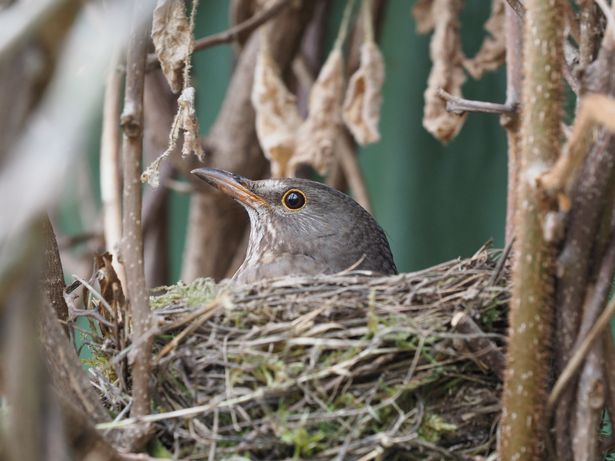 despite the winter temperatures, the blackbird female is already breeding in mid-March(Image: Getty)
They said: “Pieces of environmental legislation such as the Wildlife and Countryside Act 1981 as amended are regulated by a combination of the police, Natural England / Natural Resources Wales / Scottish Natural Heritage (based on location), the Environment Agency, the Joint Nature Conservation Committee, the Food, Farming and Countryside Commission (FFCC), the local authorities, the Partnership of Action against Wildlife Crime (PAW), various public bodies, and relevant organisations based on the endangered species in question.
“Once an action breaking the rules of the Act has been carried out, the offence will inevitably result in a police investigation.
“The police will enforce part 1 of the Act, as it focuses on the fundamental wildlife protection over wildlife species and what exactly necessitates a breach of the rules.
“In fact, dedicated departments of the police specialise in breaches of environmental and wildlife laws, such as the National Wildlife Crime Unit (NWCU) and Wildlife Crime Officers (WCOs).
“Any law relating to the environment and wildlife are taken just as seriously as any other piece of active legislation.
“Even in respect of a breach of the Act involving a single animal or habitat, the person responsible would be liable to pay a potentially unlimited fine, spend up to six months in prison, or possibly even both.”