
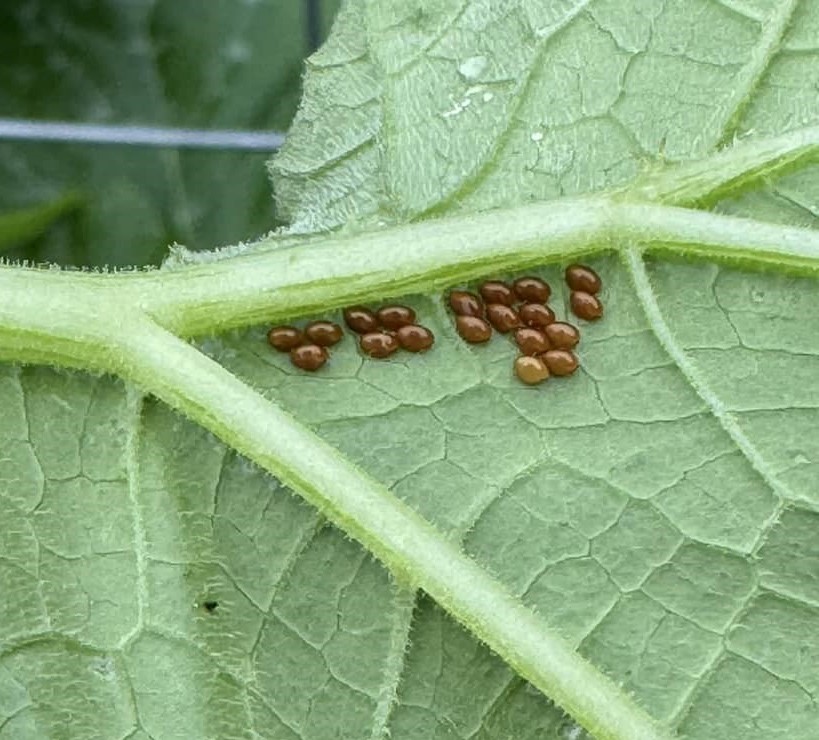
Last week, I got an email from a reader.
My reader was pleading, ‘HELP!’ Squash bug or Anasa tritis had invaded her garden. She had planted pumpkins, acorn, spaghetti, and butternut squash.
There was no hint of mercy in these squash bugs because she said, “There were millions overtaking everything.” Let’s take a military stance to annihilate this enemy.
As the general, marshal your troops and attack the coming onslaught of the enemy. Squash Bug, your enemy, has a snout that inserts into the circulatory system of the plant and drains the life out of the plant.
Trust me, your enemy’s bayonet is not rusty. Damage will appear as a wilting plant with death not far behind, which can be seen in the devastation in many gardens over the years.
This is the reason why speed in combating this insect is mandatory.
Years ago, when I took Entomology at Ohio State to learn proper tactics in combating squash bugs.
 This is a squash bug companion planting of nasturtium for squash and pepper. Credit: Eric Larson
I learned about this nemesis. The insect order, Hemiptera, translates from ancient Greek as half-winged. Hemiptera have destructive plant-eating habits, as they also have a common snout or proboscis. The Hemiptera order is more commonly referred to as the True Bugs.
One of the ideas that makes me feel better about dealing with any insect in a way that won’t harm our garden is the Integrated Pest Management paradigm. There are proper tactics for a substantial enemy.
The UN defines this IPM concept as “the careful consideration of all available pest control techniques and subsequent integration of appropriate measures that discourage the development of pest populations and keep pesticides and other interventions to levels that are economically justified and reduce or minimize risks to human health and the environment.”
The concept of IPM has been around since 1970 for safer pest control. In this time of budget restraints, even in the military, a tactic for managing funds is always wise. As you study this insect through IPM, you need to look at the issues you face.
The insect life cycle, the insect, the climate, the season of the year, and the susceptible plant all influence how to deal with the insect.
What it amounts to is that you don’t need a nuclear bomb each time you have an insect to destroy the enemy. Strategic use of your arsenal can be most effective.
Tactics have been improving, and I will review the new ideas in more depth in the second column. In the meantime, these tactics should help to manage this insect enemy.
To minimize squash bug damage, detect them early. The first step in managing squash bugs starts in the previous year, which involves getting rid of the squash plant debris.
If you have a lawn torch, go over the area where the squash bugs were feeding on the plants and kill any leftover eggs. Flame throwers were effective in World War II.
Yellow scouting strips of adhesive should reveal the early activity of your enemy. Cover your squash rows early in the season with floating row covers.
You need to make sure that your squash plants are protected and well-secured in their bivouac.
As the season progresses, remove the row covers so that the squash pollinators can do their jobs when the flowers are in bloom. Hand-pollination can also happen if you choose to leave the row covers on the row.
Marshaling your allies early in the season, such as companion plants for squash, may repel squash bugs. Studies have shown that nasturtiums, marigolds, and icicle radishes repel squash bugs.
Fragrant herbs such as dill, lemon balm, peppermint, and parsley can be planted around squash to repel Squash bugs.
Among your allies, you will find ladybugs and tachinid flies that feed on Squash bugs.
Therefore, growing plants that these insects like need to be included in your arsenal.
Among the desirable plants for these allies are sweet clover, cilantro, dill, and anise hyssop. Include these plants in your garden to enhance your arsenal as you face the onslaught of Squash bugs.
I hope you have a great stroll through your garden. If you have uninvited visitors, send me an email with some pictures to ericlarson546@yahoo.com. I will help you develop a strategy for defending your garden.
Thank you for participating in our column with your questions.
Appreciate this reporting? Help us do more
Every donation, big or small, helps our reporters tell the stories that connect our community.
Thank you for your generosity! Please note that a one-time or recurring donation is separate from Source Membership, which provides additional benefits and ongoing support for our work.
How is my donation tax-deductible?
We have a fiscal sponsorship with The GroundTruth Project, allowing our readers to support our work and benefit from a tax deduction at the same time.