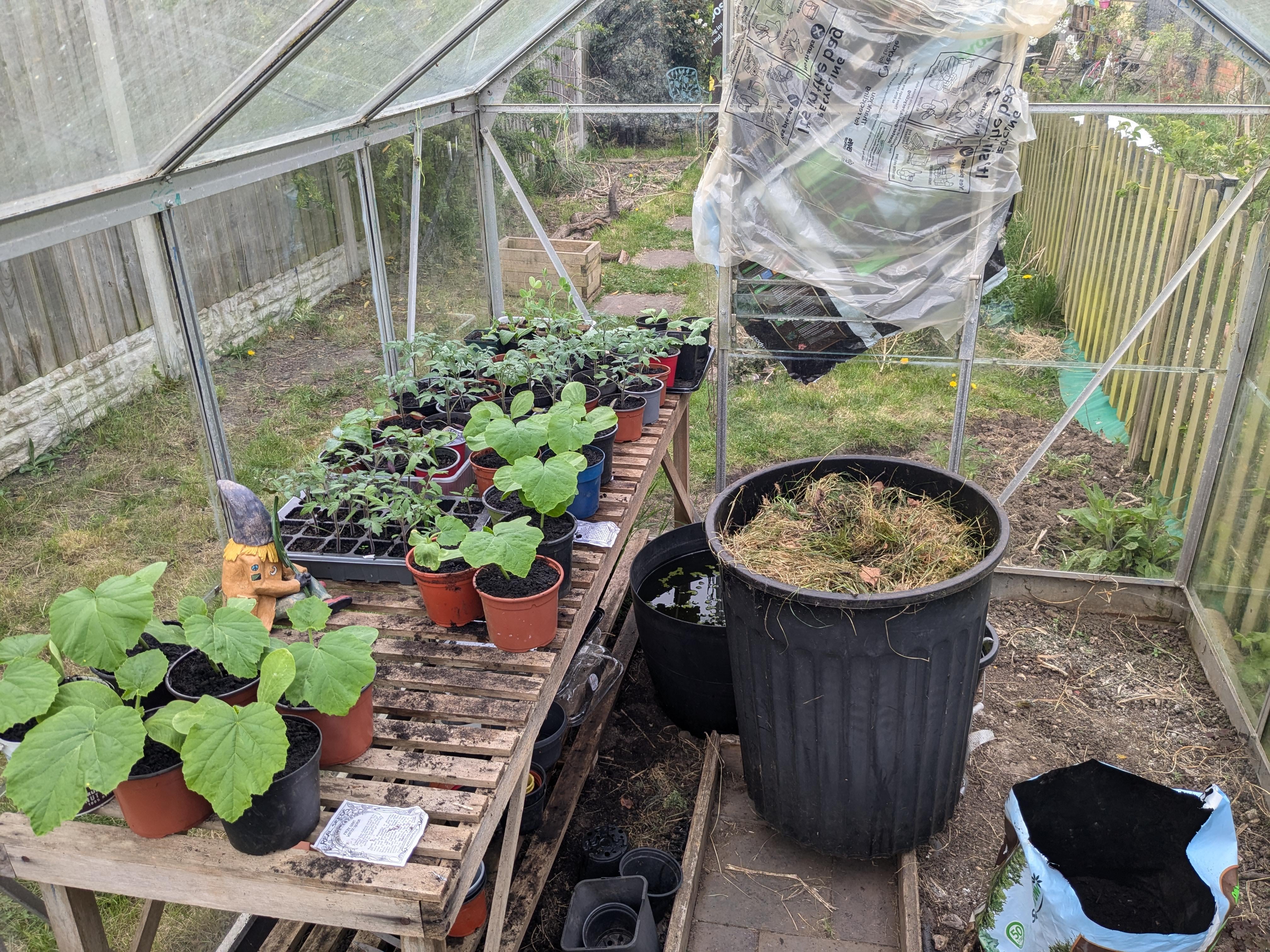
If your greenhouse is still feeling a little chilly at night and you’ve got a bunch of seedlings on the go, just move your bin full of grass clippings in to heat it up!
by Flux_Equals_Rad

If your greenhouse is still feeling a little chilly at night and you’ve got a bunch of seedlings on the go, just move your bin full of grass clippings in to heat it up!
by Flux_Equals_Rad
2 Comments
How many degrees does that warm the greenhouse overnight?
I took the liberty of asking chatgpt what it thought about the feasibility of the calculation. as i expected the wattage of the material is low but not infinitely so. the volume of the unit is bigger in reality than in calculation. but if the temperature is hugging at 40F a couple degrees is nothing to sneeze at. theres limits to the calculation and whether its half or 4th of the actual its still a nonnegligible rise at those low temps for cost of absolutely nothing
Chat gpt snippet follow:s
Let’s break this down step-by-step:
1. Estimating the Power (Watts) from Decomposing Grass Clippings
Heat output from composting grass clippings typically ranges from 100 to 300 watts per cubic meter. Grass clippings alone are moderate producers, typically around 150 watts per cubic meter.
– Volume of 32-gallon trashcan:
1 gallon = 0.00378541 m³
32 gallons ≈ 32 × 0.00378541 ≈ 0.1211 m³
– Heat generation:
Assuming about 150 W/m³ average compost heat production:
0.1211 m³ × 150 W/m³ ≈ 18.2 W
So, the approximate heat output is ~18 Watts continuously.
2. Estimating the Temperature Rise in a Small Greenhouse
Let’s assume a small hobby greenhouse size of roughly 6 ft × 6 ft × 6 ft:
– Convert to meters:
6 ft = 1.83 m
Greenhouse volume:
1.83 m × 1.83 m × 1.83 m ≈ 6.13 m³
– Air density and specific heat:
Air density ≈ 1.225 kg/m³
Specific heat of air = 1005 J/kg·K
– Mass of air inside greenhouse:
6.13 m³ × 1.225 kg/m³ ≈ 7.51 kg
– Heat required to raise air temperature by 1°C:
Q = mass × specific heat × ΔT
Q = 7.51 kg × 1005 J/kg·K × 1 K ≈ 7548 J
– Energy output overnight (10 hrs):
18.2 W × 3600 s/hr × 10 hrs ≈ 655,200 J
– Idealized temperature rise (no heat loss):
ΔT = 655,200 J / 7548 J/K ≈ 86.8°C
This idealized number (~87°C) is unrealistically high because we ignored heat losses.
3. Realistic Estimate (accounting for heat loss):
In reality, greenhouses rapidly lose heat (conduction, convection, radiation). A small heat source (~18 W) in a small, moderately insulated hobby greenhouse typically raises temperatures about 2–4°C (3.6–7.2°F) above ambient overnight.
With ambient nighttime temperature at ~40°F (4.4°C), realistically expect:
A modest temperature increase of around 2–4°C (3.6–7.2°F).
Summary:
| Factor | Value |
|———————————-|——————————-|
| Trashcan (32 gal.) heat output | ~18 W |
| Idealized temp increase (no loss)| Unrealistically high (~87°C) |
| Realistic temp increase | About 2–4°C (3.6–7.2°F) |
Practically, your 32-gallon trashcan of decomposing grass clippings will yield around 18 Watts, realistically raising the temperature of your small greenhouse by about 2–4°C (3.6–7.2°F) overnight when ambient is around 40°F.